


The Power of the Swench Tool: A Look at Heavy-Duty Torque in Action with Imperial Diesel Service
In the world of diesel engine repair—especially when it comes to marine engines, industrial power units, and large-frame commercial equipment—having the right tools can make the difference between a straightforward job and a grueling, time-consuming battle. Among the tools trusted by professional diesel mechanics, one stands out for its raw torque, mechanical simplicity, and unmatched durability: the Swench tool.
In a recent video shared with us, Dion from Imperial Diesel Servicedemonstrates his Swench tool in action, providing an up-close look at how this powerhouse of a torque tool operates in real-world conditions. The video is short, but it immediately communicates why mechanics who specialize in Detroit Diesel, Cummins, and Caterpillar engines continue to rely on the Swench tool decades after it first came onto the market.
This article explains what a Swench tool is, how it works, why diesel mechanics consider it indispensable, and why Dion’s demonstration highlights its value in heavy-duty engine service work.
What Exactly Is a Swench Tool?
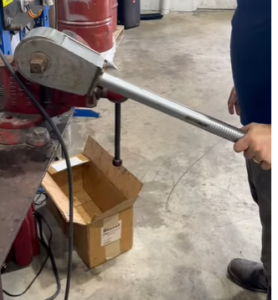
Swench Tool
A Swench—sometimes referred to as a “torque-multiplying power wrench”—is a mechanical torque tool used to break loose or tighten large bolts and fasteners that standard impact guns or breaker bars struggle with. The tool was originally developed by Williams (a division of Snap-On) and was designed for use in heavy-duty industrial, military, and marine environments.
Unlike pneumatic or electric impact wrenches, the Swench tool is 100% mechanical. It uses an internal gear train driven by manual force to multiply torque dramatically. With just a small amount of input from the mechanic’s hands, the tool can generate extremely high torque output—enough to loosen bolts that have been seized for years or torque down critical components to exact specifications.
Key Features of the Swench
-
No air or electricity required
-
Precise torque outputin both tightening and loosening
-
Shock-free operation(unlike impact wrenches)
-
Massive torque multiplicationvia internal gearing
-
Built for extreme durabilityin harsh environments
-
Safe to use on sensitive or precision components
Because it operates mechanically without hammering, the Swench is ideal for applications where impact vibrations could damage the engine or mounting surfaces.
The History of the Swench Tool: A Legacy of Heavy-Duty Engineering
Before the era of battery-powered impacts and electronic torque wrenches, mechanics working in heavy industry needed a tool that could deliver massive torque reliably, safely, and without electricity. This need led to the creation of the Swench tool, one of the most iconic torque-multiplying devices ever developed.
The Swench was originally engineered and manufactured by Williams Tool Group, a brand that later became part of the Snap-On Industrial Division. Created in the mid-20th century, the Swench was designed for military, marine, mining, railroad, and construction applications—industries where large fasteners and difficult working conditions made traditional wrenches and breaker bars impractical or dangerous. Air tools were not always available, and in many environments, they were not even an option.
The early Swench tools were entirely mechanical by design. Their internal torque-multiplying gear system allowed technicians to apply enormous torque output with manageable input force. This made the tool invaluable for field mechanics working far away from shops or power sources. In fact, the U.S. Navy, Army Corps of Engineers, and commercial maritime fleets quickly adopted the Swench for engine, shaft, and structural fastener service.
For decades, the Swench became a “must-have” tool for anyone working on large diesel or industrial equipment. Mechanics valued it because it didn’t rely on air hoses, compressors, or electricity—just mechanical ingenuity. Many of the early Swench wrenches built in the 1960s and 1970s are still in service today, a testament to their rugged design and durability.
Although advancements in power tools have changed the landscape, the Swench’s reputation remains unmatched in certain applications. In marine engine rooms, remote job sites, and heavy equipment repair, its blend of simplicity, precision, and torque-multiplying power continues to make it indispensable.
Today, seasoned mechanics like Dion from Imperial Diesel Service carry the tradition forward, using Swench tools to service Detroit Diesel, Cummins, Caterpillar, Twin Disc, and other commercial-grade equipment. The fact that the tool is still used—and still trusted—decades after its creation is a tribute to its engineering excellence and the rugged industries it was built to support.
Why Diesel Mechanics Still Rely on the Swench
Diesel engines—especially large two-stroke Detroits, high-compression Cummins units, or Caterpillar industrial engines—use bolts and fasteners that require significant torque. Head bolts, blower mounts, crankshaft bolts, flywheel fasteners, and main bearing caps cannot be loosened or tightened with ordinary tools.
Where impact guns fail, and where torque wrenches become impractical, the Swench tool excels.
Perfect for Marine and Industrial Environments
Marine engine rooms often lack the space or power supply for large air compressors. Industrial sites frequently involve remote locations. In these situations, the Swench shines because:
-
It needs no power source
-
It produces controlled torque
-
It works in tight, awkward spaces
-
It withstands extreme temperatures and conditions
This is a major reason why mechanics like Dion keep a Swench tool in their service trucks. When power tools can’t reach or don’t offer enough torque, the Swench always delivers.
Why the Swench Tool Is Essential for Detroit Diesel Work
Detroit Diesel engines—especially the classic 53, 71, 92, and 149 series two-stroke models—use a significant number of large, torque-critical fasteners. For example:
-
Cylinder head bolts
-
Main and rod bearing bolts
-
Blower and accessory drive bolts
-
Flywheel bolts
-
Gear train and camshaft hardware
These components require precise torque values, and the tolerances are unforgiving.
The Swench tool allows the mechanic to:
-
Break frozen bolts without damaging the block or threads
-
Achieve exact torque without overshooting
-
Work safely in confined engine rooms
-
Avoid the hammering force of impact guns that could fracture old castings
This makes the Swench almost a required tool for any shop working on older Detroit engines, especially marine engines that may have corrosion or heat-cycle fatigue.
Versatility Across Brands: Not Just for Detroit Diesels
While the Swench is especially popular in Detroit Diesel work, it is just as valuable for:
-
Cumminsengines, including KTA, N-Series, ISX, QSK and others
-
Caterpillarengines such as 3400, 3500, and C-Series
-
John Deeremarine and industrial engines
-
Twin Disc and Allisonmarine transmissions
-
Hydraulic pumps and PTO systems
Any piece of machinery that uses high-torque fasteners can benefit from the Swench’s precise torque delivery.
Mechanical Reliability: Why a Manual Tool Still Wins in 2025
Modern technology has created advanced torque tools, battery-powered impacts, and digital torque systems. Yet, none replace the Swench tool in rugged commercial settings. Why?
1. Dependability
No batteries to charge. No air lines to connect. No motors to fail.
2. Consistency
Mechanical torque multiplication is extremely reliable and repeatable.
3. Control
A mechanic can “feel” the torque through the tool—something electronic tools can’t offer.
4. Longevity
Many Swench tools from the 1970s and 1980s are still in service today.
5. Universality
Wherever the mechanic goes, the Swench goes. Field service work becomes much easier when your main torque tool doesn’t require electricity.
A Tool Trusted by Professionals Who Can’t Afford Downtime
Dion’s demonstration highlights an important truth about diesel work: Problems don’t care about convenience. A seized bolt in the wrong place can shut down a tugboat, workboat, generator, or industrial machine for days. In commercial settings, downtime costs money—and lots of it.
A Swench tool gives mechanics a way to solve problems fast, safely, and reliably.
Professionals like Dion rely on it because:
-
It prevents broken bolts
-
It protects expensive castings
-
It applies exact torque
-
It works anywhere
-
It lasts for decades
It is not just a tool—it is a solution.
Final Thoughts
The video of Dion using his Swench tool is more than just a demonstration; it’s a tribute to the timeless value of simple, effective, heavy-duty engineering. The Swench remains one of the most powerful and reliable torque tools ever built, relied on by diesel mechanics who work on engines where failure is simply not an option.
Dion’s hands-on demo shows why experienced mechanics continue to trust tools like the Swench. When the job demands power, precision, and durability, nothing beats it.