


Understanding the Detroit Diesel 8V92TI: RPMs, Power Management, and the Importance of a Reliable Tachometer
The Detroit Diesel 8V92TI is one of the most respected engines in the two-stroke diesel world. Known for its power, responsiveness, and durability, the 8V92TI has powered everything from sportfishing boats to passenger ferries, patrol vessels, commercial workboats, and heavy industrial equipment. Its blend of turbocharging (the “T” in TI) and intercooling (the “I”) gives it a higher horsepower rating, better torque curves, and improved thermal efficiency compared to naturally aspirated or turbo-only Detroit Diesel configurations.
Like all Detroit Diesel two-stroke engines, the 8V92TI is designed to run within very specific RPM ranges. RPM—revolutions per minute—is more than just an indicator of speed. On a two-stroke Detroit, RPM directly reflects combustion quality, scavenging efficiency, turbocharger performance, blower load, fuel delivery, propeller load, and overall engine health. Operators who understand what their RPM readings are telling them gain a powerful diagnostic tool, helping them maintain performance, detect issues early, and extend engine life.
At the center of this is one of the most overlooked—but essential—instruments on the dashboard: the tachometer. Without an accurate tachometer, an operator loses the ability to read what the engine is communicating in real time.
Shop Electric Tachometers (12 Volts)
Shop Electric Tachometers (24 Volts)
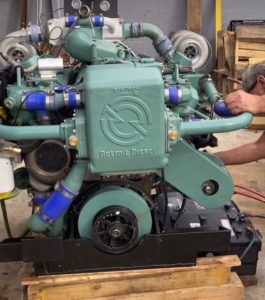
Overview of the Detroit Diesel 8V92TI
The 8V92TI is an 8-cylinder, V-configuration, 92-cubic-inch-per-cylinder, two-stroke diesel engine equipped with both a turbocharger and an intercooler. The blower supplies the air required for scavenging and combustion, while the turbocharger increases air mass flow and boosts horsepower. The intercooler further improves air density by cooling the compressed air before it enters the cylinders.
These features resulted in higher horsepower ratings—typically from 550 HP to well over 750 HP depending on configuration—and a flatter, more efficient torque curve. Because the engine is turbo-intercooled, correct RPM management is especially important, as both turbo speed and exhaust temperature are closely linked to engine speed.
See Our Parts Catalog For The Detroit Diesel 8V92 Turbo Engine
What RPMs Really Mean on an 8V92TI
RPM stands for revolutions per minute , but for a Detroit Diesel operator, RPM represents a complex blend of engine conditions. Unlike many modern electronically controlled engines, the 8V92TI communicates its internal state mechanically, and RPM is one of the clearest signals.
Here is what RPM tells you:
1. Engine Load
RPM is one of the primary indicators of load. A properly propped vessel should allow the 8V92TI to reach its rated wide-open throttle RPM—typically 2,100 to 2,300 depending on the exact rating.
- If the engine cannot achieve rated RPM, the boat is likely over-propped or overloaded.
- If it exceeds rated RPM easily, it may be under-propped or the tachometer could be inaccurate.
Running overloaded prevents the turbo from reaching ideal boost, increases exhaust temperature, and shortens engine life.
2. Turbocharger Health
Turbo boost and RPM are linked. As RPM increases, exhaust energy rises, which spins the turbocharger faster and increases boost.
If RPM rises but the engine feels weak or fails to produce expected horsepower, it may indicate:
- Turbo lag or turbo wear
- Exhaust restrictions
- Fuel starvation
- Blower sealing issues
Operators use RPM changes to detect when the turbo is not performing within expectations.
3. Fuel System Performance
The unit injectors on an 8V92TI are mechanically actuated by the camshaft and governed by rack settings. Poor RPM behavior can reveal:
- Rack misalignment
- Worn injectors
- Dirty fuel filters
- Air leaks in fuel supply
- Timing issues
Sluggish acceleration, inability to hold RPM, or uneven RPM changes can indicate injector or rack problems.
4. Cooling System Stress
RPM also affects temperature. Higher RPM increases heat production, cooling system pressure, and coolant flow. If the engine climbs to high temperatures at moderate RPM, it suggests:
- Heat exchanger scaling
- Low raw water flow
- Failing seawater pump impeller
- Restricted intercooler
On a TI engine, cooling efficiency is critical since the turbocharger adds significant heat.
5. Scavenging and Combustion Quality
In a Detroit two-stroke, every revolution is a power stroke. RPM directly controls how efficiently the blower can scavenge exhaust gases from the cylinders. Poor RPM stability can signal:
- Blower wear
- Exhaust leaks
- Airbox restriction
- Cylinder imbalance
If RPM dips or surges at idle or low speed, it is often related to scavenging or air handling issues.
6. Propeller Condition and Hull Fouling
A sudden loss of RPM at full throttle—without any mechanical changes to the engine—often has nothing to do with the engine itself.
It can indicate:
- Barnacle growth
- Propeller damage
- Rope or weeds around the prop
- Excessive hull drag
For this reason, RPM is not just an engine indicator; it’s a performance indicator for the entire propulsion system.
The Meaning of Specific RPM Zones on an 8V92TI
Understanding how the engine behaves in different ranges helps an operator use RPM as a diagnostic tool.
Idle (500–650 RPM)
Smooth idle indicates:
- Proper injector balancing
- Correct rack settings
- Healthy blower seals
A rough or unstable idle often points toward an injector issue, air leak, or uneven cylinder compression.
Low to Mid Cruising Range (1400–1800 RPM)
This is the most used zone for most operators.
At these RPMs:
- Turbo begins to produce steady boost
- Fuel efficiency is optimal
- Temperatures remain stable
- Exhaust smoke should be minimal
If smoke appears or the engine struggles to maintain RPM, fuel system or air supply problems may be present.
High Cruise (1800–2000 RPM)
This is where the 8V92TI produces strong power but generates more heat.
This zone is where cooling system weaknesses reveal themselves. Rising temperatures at high cruise often indicate restricted heat exchangers, dirty aftercoolers, or a weak seawater pump.
Wide-Open Throttle (2100–2300 RPM)
Maximum RPM is the most important measurement on the entire boat.
If the boat cannot reach rated RPM:
- The propeller is overloaded
- The hull is fouled
- Turbo or fuel delivery is deficient
- The tachometer is inaccurate
Failing to reach rated RPM significantly reduces engine life and increases exhaust temperatures.
Why an Accurate Tachometer Is Essential
For an 8V92TI, the tachometer is not a convenience—it is a critical engine health instrument.
An inaccurate tachometer can cause:
- Running the engine overloaded without realizing it
- Failing to reach proper WOT RPM
- Incorrect synchronization between twin engines
- Misinterpretation of fuel burn versus load
- Higher exhaust temperatures
- Reduced turbo life
- Increased risk of engine damage
Operators who “run by ear” instead of by tachometer often unknowingly stress their engines.
A good tachometer should be:
- Properly calibrated
- Free from wiring issues
- Matched to the alternator or magnetic pickup system
- Checked routinely against hand-held optical tachometers
Twin-engine vessels especially rely on accurate tachometers to achieve proper synchronization, smooth operation, and balanced load.
Conclusion
The Detroit Diesel 8V92TI remains one of the most capable engines ever built in the two-stroke diesel world. Its turbo-intercooled design delivers strong horsepower, excellent throttle response, and impressive durability—but only when managed correctly.
RPM is the engine’s most important real-time communication tool. It tells you about load, combustion health, turbo performance, fuel delivery, cooling system effectiveness, and the condition of the entire propulsion system.
A reliable, accurate tachometer is essential for reading these signals. Without it, operators cannot properly manage engine load, detect early warning signs, or maintain long-term engine health.
Understanding RPM behavior—and trusting the tachometer that displays it—is one of the most valuable skills an 8V92TI owner can develop.
Shop Electric Tachometers (12 Volts)
Shop Electric Tachometers (24 Volts)